How to Protect Your Betting Budget This Season

The 2026 World Cup ran from June 11 to July 19, and for a month straight, a football fan's calendar turned into scheduled chaos. A favourite crashed out in the group stage, kickoff times kept shifting, and some of the matches that mattered most landed at 2 am on a Tuesday.
Money habits shifted right along with it-bets got placed faster and with more emotion than usual. Fans who followed the schedule and the odds through Afropari Nigeria had a simple approach: check the schedule first, then check team form, and only after that decide how much of the week's budget was worth putting down. Looking back at the tournament, here is what held up.
Set Your Stake Before Kickoff
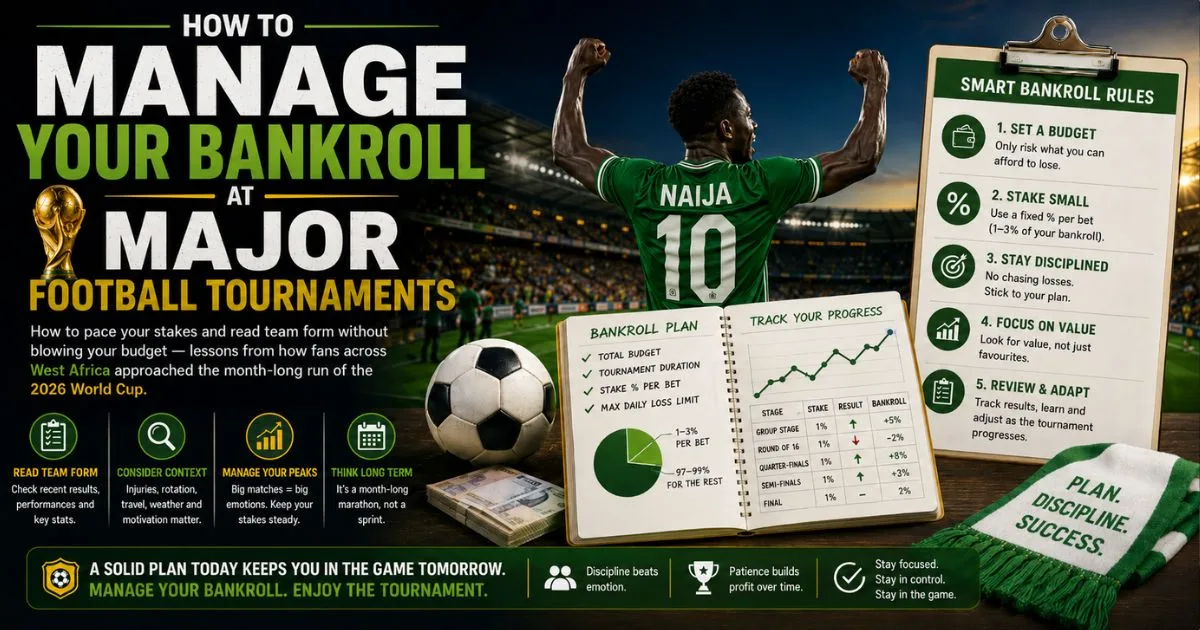
Bankroll planning rarely happens ahead of time-it tends to come to mind only after the money is gone, which makes sense: with a last-minute goal on the line, budget talk is not top of mind. Setting a plan in advance is what kept that in check.
A few things that helped over the course of the tournament:
- Setting aside a fixed amount for betting for the whole tournament before it started, rather than deciding week to week.
- Keeping stakes smaller during the group stage, when team form is still hard to read and picking the stronger sides is largely guesswork.
- Deciding on a stake before the match started, not while it was underway. Odds shift in the final ten minutes before kickoff, and that shift can crowd out clear thinking.
- Keeping a single-match stake to roughly 2-3% of the total bankroll, regardless of tournament stage.
A team reaching the later rounds does not automatically make a prediction more reliable. It is still worth reassessing form and context match by match, rather than assuming later-stage bets carry less risk.
Watch the Team, Not Just the Score
One weak half does not erase a strong qualifying run, and one lucky deflection does not turn a weak side into a strong one. It is an easy trap during a tournament-reacting to the last ten minutes instead of the last ten matches.
Worth checking before placing a bet:
- Squad rotation. Once qualification was secured, coaches started resting key players. A lineup that looked “weak” on paper often played differently on the pitch.
- Travel and climate. Not every host city matched the conditions a team was used to, and that showed by the second half.
- Recent head-to-head meetings. More useful than results from a different competition entirely.
- Fresh injury news. Player form can change day to day, so matchday updates carried more weight than news from a few days earlier.
Common Mistakes and How They Played Out
Bettors tend to make the same mistakes in almost every tournament. None of them wrecks a bankroll on its own, but together they add up. Here is how they played out this time around, and what worked better instead:
| Mistake | Why It Hurts | How to Fix |
|---|---|---|
| Chasing losses after an unexpected result | Turns one bad stake into three | Set a limit in advance and step away if it is reached |
| Betting on every match out of habit | Spreads attention and money too thin | Pick two or three matches genuinely worth it |
| Ignoring kickoff time zones | Late-night bets get placed half-asleep | Check the schedule the evening before, not five minutes out |
| Treating the group stage like the final | Overreacting to a small sample size | Two matches offer an early read, not a confirmed trend—weigh them against other context before adjusting |
A Note on Responsible Play
Betting stays entertainment, not income, and a fixed, pre-set budget is what keeps it that way. Setting limits ahead of time-and sticking to them regardless of how a match is going-is generally more effective than trying to manage decisions in the moment.