Football scouting once depended on intuition, VHS recordings, and exhausted scouts driving across rainy industrial towns hoping the next teenager they watched would eventually become worth €50 million.
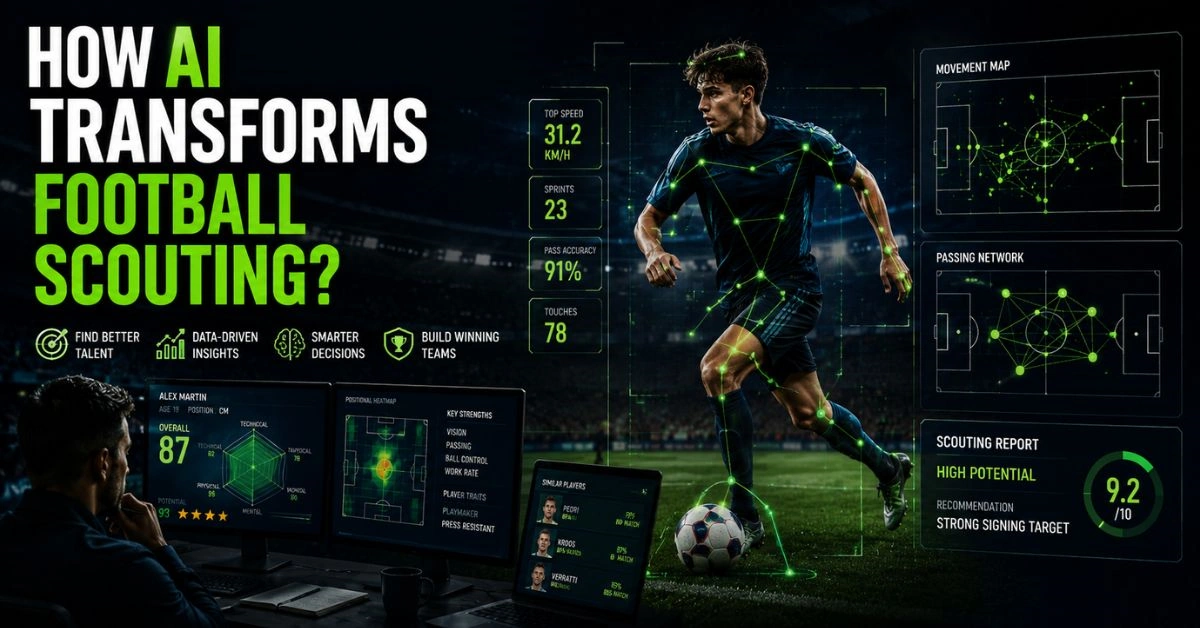
Modern football operates differently. Artificial intelligence now studies movement patterns, passing speed, sprint decline, tactical reactions, and even psychological consistency under pressure, turning recruitment into something closer to predictive analytics than traditional talent hunting.
Even betting-focused football audiences following platforms like RajBets increasingly hear terms such as xT, pressing efficiency, and transition value because AI-driven analysis escaped club offices and entered mainstream football culture.
The sport still loves chaos, but clubs now try to measure the probability of chaos before paying for it.
The Death of Traditional Scouting Logic
For decades, scouts searched for players who looked technically gifted or physically dominant, but AI exposed how unreliable visual impressions can become over a full season.
A winger completing five spectacular dribbles may still damage his team structurally by ignoring pressing triggers or losing defensive positioning repeatedly. Modern clubs therefore measure repeatable behavior instead of isolated highlights.
A famous example is Brighton & Hove Albion F.C. signing Moisés Caicedo before he became a global star. The club looked beyond goals and focused on pressing, positioning, and decision-making data. In simple terms, Brighton used AI to notice football intelligence earlier than richer clubs did.
Traditional Scouting View | AI-Based Interpretation |
“Looks quick” | Sprint sustainability across 90 minutes |
“Creative passer” | Progressive pass success under pressure |
“Works hard” | Efficient pressing angles and recovery runs |
“Strong mentally” | Performance stability after mistakes |
“Good finisher” | Shot quality vs finishing variance |
“Technical player” | First-touch speed under pressure |
“Aggressive defender” | Duel timing and foul probability |
“Versatile” | Tactical role adaptability data |
The interesting shift is that AI often values players fans barely notice during broadcasts. Football cameras naturally follow the ball, while algorithms increasingly focus on everything happening away from it.
Several metrics became especially important in modern recruitment:
- High-intensity sprint repetition
- Weak-foot usage frequency
- Positional discipline under transitions
- Passing speed after receiving possession
- Defensive lane blocking efficiency
- Recovery distance after turnovers
- Progressive carries under pressure
- Aerial positioning timing
- Off-ball movement synchronization
- Expected threat contribution (xT)
That explains why some expensive transfers fail despite obvious talent. Football intelligence is now measured frame by frame rather than through highlight compilations and dramatic commentary clips.
AI Watches the Invisible Football Match
Modern football contains two simultaneous games: the visible one fans discuss online and the invisible one AI systems quietly analyze underneath it.
The invisible game includes spacing manipulation, pressing shadows, scanning frequency, body orientation, and movement chains created before a pass even happens.
Platforms connected to football audiences, including RajBet, increasingly integrate advanced match statistics and AI-enhanced performance indicators into football coverage because modern fans no longer consume matches passively.
Bettors now track pressing efficiency, expected goals momentum, transition speed, and live tactical patterns almost the same way recruitment analysts do.
Ten years ago casual fans debated who wanted it more; now they casually mention progressive carries during halftime conversations like miniature sporting directors.
Invisible Action | Why Clubs Care |
Pressing shadows | Cuts passing lanes without tackles |
Shoulder scanning frequency | Improves decision speed |
Body orientation before receiving | Enables faster transitions |
Decoy movement runs | Creates teammate space |
Defensive tracking discipline | Prevents tactical collapse |
Recovery positioning | Stops counterattacks early |
Pass timing under pressure | Essential in elite leagues |
Space occupation consistency | Improves attacking structure |
AI also changed how clubs evaluate mentality and tactical intelligence because raw technical ability rarely guarantees success anymore.
Recruitment departments now monitor behavioral patterns such as:
- Reaction after losing possession
- Confidence after missed chances
- Communication with teammates
- Discipline during pressing sequences
- Tactical consistency late in matches
- Emotional control after referee decisions
- Adaptation speed in new systems
- Movement discipline without the ball
- Work rate after physical fatigue
Two or three sentences of observation from an experienced scout still matter enormously, though. Algorithms can measure what a player does; they still struggle to fully explain why he behaves that way under emotional pressure.
That balance between data and instinct is why football scouting did not become robotic. It simply became harder to fool.
Key Areas Where AI Outperforms Human Observation:
Area | AI Advantage |
Long-term pattern tracking | Processes thousands of matches |
Injury prediction | Detects physical workload trends |
Tactical comparison | Compares players across leagues |
Movement analysis | Tracks off-ball actions constantly |
Passing networks | Measures team interaction quality |
Fatigue detection | Identifies performance decline early |
Pressing structure | Evaluates defensive coordination |
Transfer valuation | Projects market efficiency |
At the same time, football still produces absurd moments no system predicts properly. One random deflection, one emotional derby atmosphere, or one goalkeeper entering temporary superhero mode can destroy every elegant statistical model within minutes. That is partly why people still love the sport.
Football Recruitment Now Looks Like Financial Trading
Modern clubs increasingly treat players like volatile assets whose value can rise or collapse depending on age, injuries, league adaptation, and tactical compatibility. AI accelerated this transformation dramatically because predictive modeling allows teams to identify undervalued talent earlier than competitors.
Recruitment meetings today often resemble hedge-fund presentations mixed with football arguments.
Recruitment Goal | AI Application |
Buy low, sell high | Market value projection |
Reduce transfer risk | Injury probability analysis |
Improve tactical fit | System compatibility modeling |
Increase resale value | Age-curve forecasting |
Protect wages budget | Output-to-salary evaluation |
Replace aging stars early | Long-term succession planning |
Find hidden leagues | Competition-strength weighting |
Improve squad balance | Positional age distribution |
The obsession with younger players suddenly makes sense once clubs realize AI can compare current prospects against thousands of historical development paths. Football is still emotional, but recruitment became aggressively mathematical.
Modern scouting departments now prioritize factors like:
- Tactical flexibility – can the player fit different tactical systems?
- Injury resistance trends – is the player physically reliable long-term?
- Psychological resilience – how well does he handle pressure and setbacks?
- Adaptation to pressing systems – can he survive high-tempo football?
- Consistency across competitions – does performance remain stable everywhere?
- Decision speed in transitions – how quickly does he react during counterattacks?
- Positional intelligence – does he move intelligently without the ball?
- Market resale potential – could his transfer value grow later?
- Physical sustainability across seasons – can he maintain elite intensity for years?
- Multi-role usability – can coaches use him in multiple positions?
The result is a football economy where mid-sized clubs sometimes recruit smarter than global giants because their models identify talent before hype explodes online. In some ways, the smartest recruitment department now matters almost as much as the richest owner.
Why Smaller Clubs Adopted AI Faster:
Reason | Effect |
Smaller transfer budgets | Fewer mistakes allowed |
Limited scouting staff | Data expands coverage |
Need for resale profit | Earlier talent discovery |
Competition with rich clubs | Smarter market timing |
Lower media pressure | Easier experimentation |
Recruitment efficiency | Faster decision-making |
Access to global leagues | Wider talent pool |
Financial survival | Better investment accuracy |
Football may still look emotional from the stands, but behind the scenes the sport increasingly runs on predictive systems, risk management, and data interpretation.
The scout with a notebook still exists; now he simply sits next to three analysts watching twenty dashboards at the same time.
Conclusion
AI transformed football scouting from subjective observation into a hybrid system combining predictive analytics, tactical modeling, and human expertise.
Clubs now evaluate players through movement patterns, decision speed, injury probability, and psychological consistency rather than highlights alone.
Yet football remains too chaotic to become fully programmable, which is exactly why even the smartest algorithms still need experienced people beside them interpreting what numbers cannot completely explain.