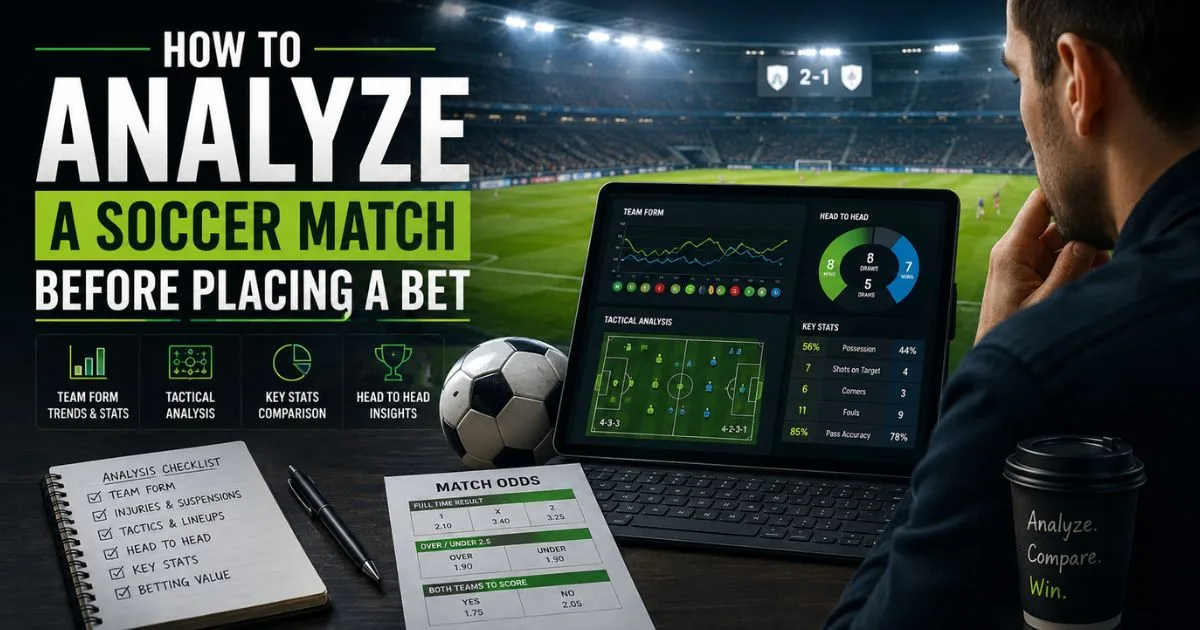
Soccer betting rewards preparation. Most people skip straight to the odds and wonder later why they keep losing. The difference between a guess and a USDT betting decision grounded in evidence is the analysis you do before the match kicks off, and it does not require a statistics degree to do it properly.
Start With the Right Question
Before pulling up any data, decide exactly what you are predicting. Are you betting on the match result, total goals, both teams to score, or something narrower like corners? Tactiq's framework makes this the mandatory first step, and it matters because the data you need for a 1x2 soccer bet differs from what you would examine for an over/under market.
Livescore echoes this, recommending that bettors match their statistical research to the specific bet type: over/under markets need goal-rate data, BTTS markets need defensive suppression numbers, and so on.
ScoreLab adds a useful pre-step before you even open a statistics page: identify the league, note the match's importance-such as a derby, relegation six-pointer, or dead rubber—and confirm which side is at home. These three facts shape everything that follows.

Build Your Form Picture Correctly
The standard advice to “check form” is almost always applied incorrectly. People look at the last five results and read wins as confidence and losses as weakness. That is only the surface.
MatchInsight's checklist draws a useful distinction: use the last five matches to read momentum and the last ten matches to identify pattern stability. A team on a three-game losing run might still show a stable xG profile across ten games, meaning the results could reflect variance rather than a genuine decline. That context matters enormously for soccer prediction accuracy.
Tactiq goes further, recommending that you compare xG created and conceded across the last five to eight matches rather than relying only on raw goals. A team outscoring its xG by a wide margin may be due a correction, while one consistently underperforming its xG could be close to turning its form around.
Cross-checking the official league table against an expected-points table gives you a cleaner view of which teams are genuinely strong and which may have benefited from fortunate results.
Weight matters too. Recent matches should count more than older ones, and games against opponents of similar quality should usually carry the most relevance.
The Lineup Problem Most Bettors Ignore
A significant number of prediction errors trace back to lineup assumptions. Analysts build their assessment around a team's attacking output and then fail to account for the absence of the player responsible for generating much of that output.
The Medium betting guide is direct on this point: analyse an opponent's chances only after the starting lineups are announced. Tactiq recommends finding the probable starting eleven rather than scanning the entire squad, and then identifying which absences actually change the team's functioning.
A backup striker may have limited impact. A missing defensive midfielder who controls pressing triggers can completely alter a team's xG profile.
This is one area where watching matches, rather than relying only on statistics, pays dividends. Reddit's r/SoccerBetting community frequently notes that watching a team's last two or three matches from a high camera angle can reveal formation behaviour, pressing triggers, and player movement that no statistics sheet fully captures.
Head-to-Head Data and When It Actually Applies
Head-to-head records are often overused. ScoreLab recommends reviewing the last five meetings and noting any psychological edge, but the honest application of this information is narrow.
When largely the same two squads have met repeatedly during the previous two years with consistent results, head-to-head data may be relevant. When the rosters, managers, or tactical systems have changed substantially, those historical results are mostly decorative.
The more productive use of head-to-head research is identifying structural matchup problems. One example is a high-pressing team repeatedly struggling against an opponent that plays directly and bypasses the press. That tactical dynamic can persist beyond individual player changes.
The Statistical Layer: xG, Poisson, and Attacking Strength
For anyone willing to go deeper, the numbers become more precise. FutbolLab describes calculating attacking strength as goals scored at home divided by the average number of goals conceded by visiting teams across the league.
Defensive strength can be calculated using goals conceded compared with the average number of goals scored by home teams. Feeding those figures into a Poisson distribution produces probability estimates for individual scorelines.
This approach, combined with Poisson regression, forms the foundation of many professional prediction models. The Soccer Stats Vault methodology starts in a similar way: collect historical performance data, player statistics, weather conditions, and venue factors before calculating the probabilities.
For daily soccer predictions across multiple matches, a systematic process is the only sustainable method. Golsinyali's suggested time allocation provides a reasonable benchmark: five to ten minutes on form, three to five minutes on head-to-head data, ten to fifteen minutes on statistics, and another five to ten minutes on context.
That means roughly twenty to thirty minutes of research per match. Much less than that and you are probably guessing.
Context, Motivation, and the Variables Stats Miss
A team already mathematically safe from relegation, playing a mid-table side during the penultimate week of the season, presents a very different situation from the same fixture in November. Livescore's checklist highlights league position and motivation explicitly: determine what each team is actually playing for.
NerdyTips adds weather and pitch conditions, along with psychological factors such as pressure, confidence, and rivalry intensity.
The Medium guide goes deeper into the media layer as well. Press conferences, player interviews, transfer rumours, and even statements from supporter groups can reveal information about squad harmony or tactical changes before those developments appear in the statistics.
Turning Analysis Into a Probability and Knowing When to Stop
The goal of all this research is a calibrated probability triple: a percentage for a home win, draw, and away win that adds up to 100.
Tactiq defines a well-calibrated forecast as one in which outcomes assigned a 60% probability actually happen approximately 60% of the time across a large sample. That is the standard to pursue for successful soccer predictions.
When your analysis produces a clear read, assign the probabilities and compare them with the bookmaker's implied odds to identify any potential edge.
When a match still looks uncertain after thirty minutes of work, ScoreLab's advice is sensible: do not predict it. Not every fixture is suitable for a wager, and the discipline to skip unreadable matches is what separates sustainable bettors from everyone else.
Unbeatable soccer predictions are not built on betting on everything. They are built on betting selectively, with conviction, after the work is done.